Tuesday, August 3, 2010

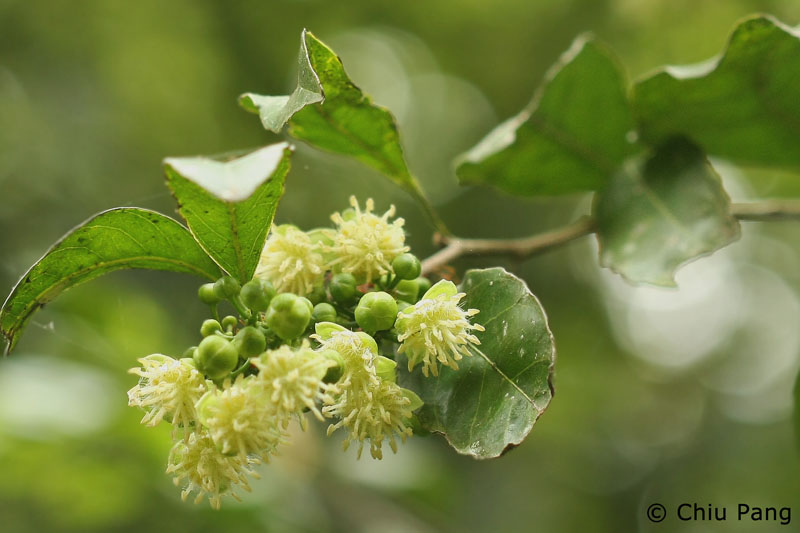
Syzygium fluviatile

There is very few information and pictures of Syzygium fluviatile (Myrtaceae) available on internet and books after some intensive search. It might be because of its globally narrow distribution as it is probably a Chinese endemic. Even so, it is only found in three provinces in China, including Guangxi, Guizhou and Hainan according to Flora of China. However, a rapid biodiversity survey report prepared by KFBG, Hong Kong, stated that this species is endemic to Hainan. Indeed, it is a very common streamside shrub in Hainan based on my own observation. The specific epithet "fluviatile" means existing in or about rivers which is very true.

Friday, July 30, 2010

Scutellaria javanica

Scutellaria javanica is a large Scutellaria species which could reach up to 1 m tall and has relative large flowers among other Scutellaria species. In China, it is only distributed in Hainan which is a nationally uncommon species. It can also be found in Indonesia and Philippines, suggesting it is a tropical species. Its type specimen was from Java which gives its specific name, javanica.

S. javanica is believed to be fairly common in Hainan which is mainly found near water or along streams. It is remarkably easy to identify by its large individual and dark purple flowers.

Tuesday, July 27, 2010

Canthium horridum

Canthium horridum is a common weedy shrub in Hainan Island but a rare species in Hong Kong. Rubiaceae is a tropical family which is very diverse and predominant in Asian tropical regions. Identifying Rubiaceae is not difficult in field by its opposite leaves, persistent stipules and lack of latex. Some of its members are armed with thorns though it is quite uncommon.

Monday, July 12, 2010

Hydnocarpus hainanensis

Hydnocarpus hainensis is a restrictedly distributed species in Southeast Asia which is ranged from southern China to Vietnam. The Chinese population is mostly restricted in Hainan Island. It is listed as vulnerable according to the IUCN Redlist though its status might be outdated. However, as it is mainly found in low altitude in mountaneous regions where deforestation is serious, it still constitutes certain level of conservation importance.

Based on the on-site observation, flowers emit some unpleasant smell like spoiling food. Flowers in anthesis are very easy to detach where mass dropping of flowers occur in strong wind.

Wednesday, July 7, 2010

Fimbristylis ovata

Sedge (family Cyperaceae) is a very diverse family among angiosperms which contains over 100 genera and about 5,500 species. 23 genera could be found in Hong Kong. Previous study (Shaw, 2000) showed that Hong Kong is particularly rich in Cyperaceae among regions nearby which is probably due to rich local habitat diversity.

Identification of Cyperaceae is difficult in field whereas floral parts and fruits are tiny. Also, photos are comparatively few on internet or books, which further makes it harder to be identified.

Above shows a locally very common Cyperaceae species, Fimbristylis ovata, which mainly inhabits grasslands and wastelands. There is only one spikelet per inflorescence which makes them relatively easy to identify.

Friday, June 25, 2010

Turraea pubescens

Turraea pubescens (Meliaceae) was found along streams in low altitude in Hainan. It is a small shrub with simple leaves and medium-sized flowers. It therefore didn't give impression of Meliaceae to me in the field as most of the known species are having compound leaves and relatively small flowers. Its roots are widely harvested and used as medicines by the locals.

Sunday, May 9, 2010

Zhenhai Brown Frog

This individual of Rana zhenhaiensis was found in Northwestern Jiangxi during daytime in late March. It looks like a typical Rana species recognized before, having a brown overall coloration and a dark ear patch. This species was firstly discovered in Zhen Hai which is a district in Zhejiang Province. It indeed has a much broader distribution which covers most part of Southeast China. It is mainly found in agricultural fields during breeding season.

Distribution map of Rana zhenhaiensis. It is endemic to China.